
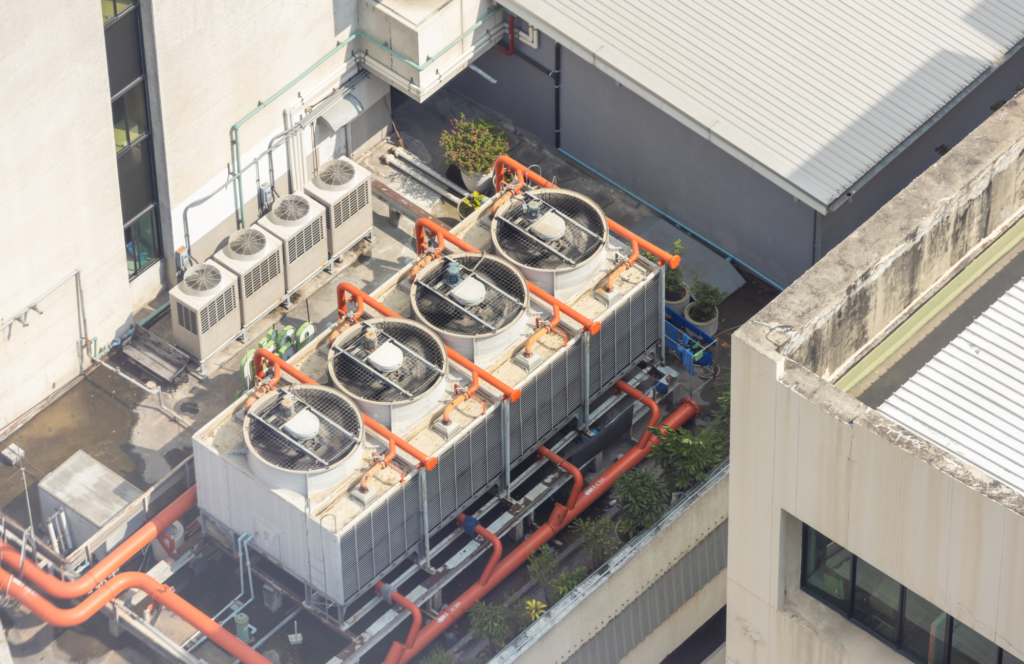
Carlton Hotel Singapore’s chiller plant is 25 years old — the kind of asset most facilities teams approach cautiously, favoring incremental maintenance over disruptive change. What makes this case worth documenting isn’t just the efficiency numbers it produced, but a genuine, unplanned comparison that played out on the same property: one system went non-chemical from day one, the other didn’t, and the six months in between made the difference visible.
The Property and the Starting Point
Carlton Hotel Singapore operates two water-cooled cooling systems — a 350 RT plant and a considerably larger 1,400 RT plant — supporting a chiller plant that has been in continuous service for a quarter-century. As with most hotels of this age and scale, the property’s sustainability ambitions (alignment with Global Sustainable Tourism Council, or GSTC, performance targets, and support for net-zero and carbon-neutral goals) had to be pursued without the capital scale of a full plant replacement.
What Actually Happened — Including the Part That Didn’t Go to Plan
The 350 RT system was commissioned onto SWATS+ non-chemical treatment in September 2024. The 1,400 RT system took a different path initially: its cooling tower infills had just been replaced, and rather than pairing new infill media with non-chemical treatment from the outset, the property continued with traditional chemical treatment on that system.
Within six months, scale had already begun building up on the 1,400 RT system’s brand-new infills — significant enough to require a full cleaning before the property transitioned that system to SWATS+ in April 2025. It’s a real-world illustration of a pattern worth naming plainly: chemical treatment on freshly installed infill media isn’t automatically safe simply because the equipment is new, and the assumption that it is can cost six months of accumulated scale before anyone revisits the approach. Had the 1,400 RT system started on SWATS+ alongside the 350 RT system in September 2024, that intervening cleaning cycle likely wouldn’t have been necessary at all.
The Results
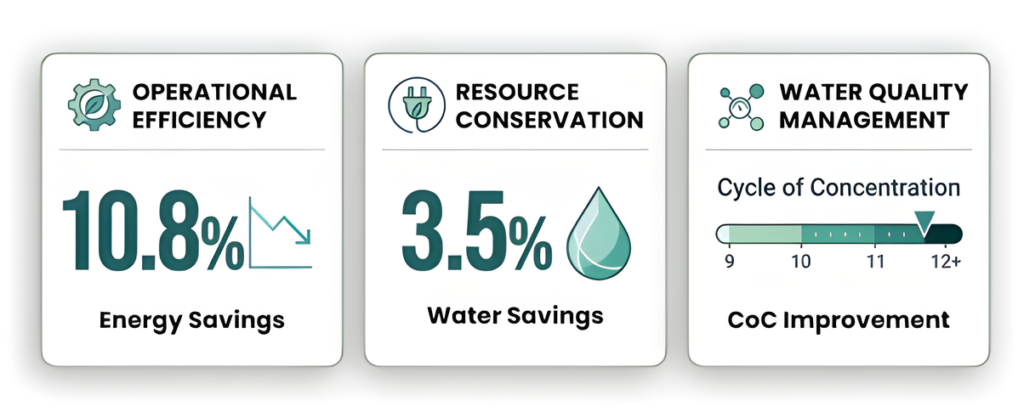
Within 12 months of full SWATS+ deployment, Carlton Hotel recorded approximately 10.8% energy savings and approximately 3.5% water savings from cooling tower water consumption.* Real-time water quality monitoring — a standard part of the SWATS+ platform — tracked Cycle of Concentration (CoC) across both cooling towers running in the 9 to 12+ range, consistent with the higher CoC levels a non-chemical approach can sustain once scale is no longer the limiting constraint on how far the water can be concentrated before blowdown.
Beyond the headline percentages, the property reported a set of operational changes that don’t always make it into a savings figure but matter directly to a facilities team’s day-to-day workload:
- Cooling tower cleaning frequency dropped from monthly to half-yearly
- Fewer man-hours spent on cleaning across both systems
- Fewer tower drain-downs for washing, since cleaning is now needed far less often. This saves water on top of the cooling tower water consumption figure above
- Reduced physical damage to infill media from pressure jet cleaning, since the towers required it far less often
- A longer expected useful lifespan for the newly installed infills specifically, now that they’re no longer being repeatedly stripped by aggressive mechanical cleaning
From the Engineering Office
Joseph Tham, Director of Engineering at Carlton Hotel Singapore, summarized the change directly: “With the new chemical-free condenser water treatment, water quality, the 25-year-old chiller plant efficiency, and the cycle of concentration improved significantly.”
What This Means for GSTC-Aligned Properties
Carlton Hotel’s results map directly onto the areas GSTC’s Hotel Standard assesses under its Environmental pillar: energy conservation and water conservation from the efficiency and CoC improvements, and greenhouse gas emissions and pollution reduction from both the lower energy draw and the elimination of chemical discharge from the condenser loop. For a property pursuing or maintaining GSTC alignment, that’s the practical value of a case like this — a single cooling plant intervention supporting multiple assessed indicators simultaneously, backed by 12 months of real, metered data rather than a projected estimate.
For hotels facing a similar starting point — an ageing chiller plant, a sustainability commitment already in motion, and a cooling tower approach that hasn’t been revisited in years — Carlton Hotel’s experience offers a specific, documented answer to the question of what changes, and what it takes to get there without a full plant replacement.
* Results vary according to actual scaling conditions and system parameters. Case study data courtesy of Carlton Hotel Singapore and HannveTech’s own project documentation.


